
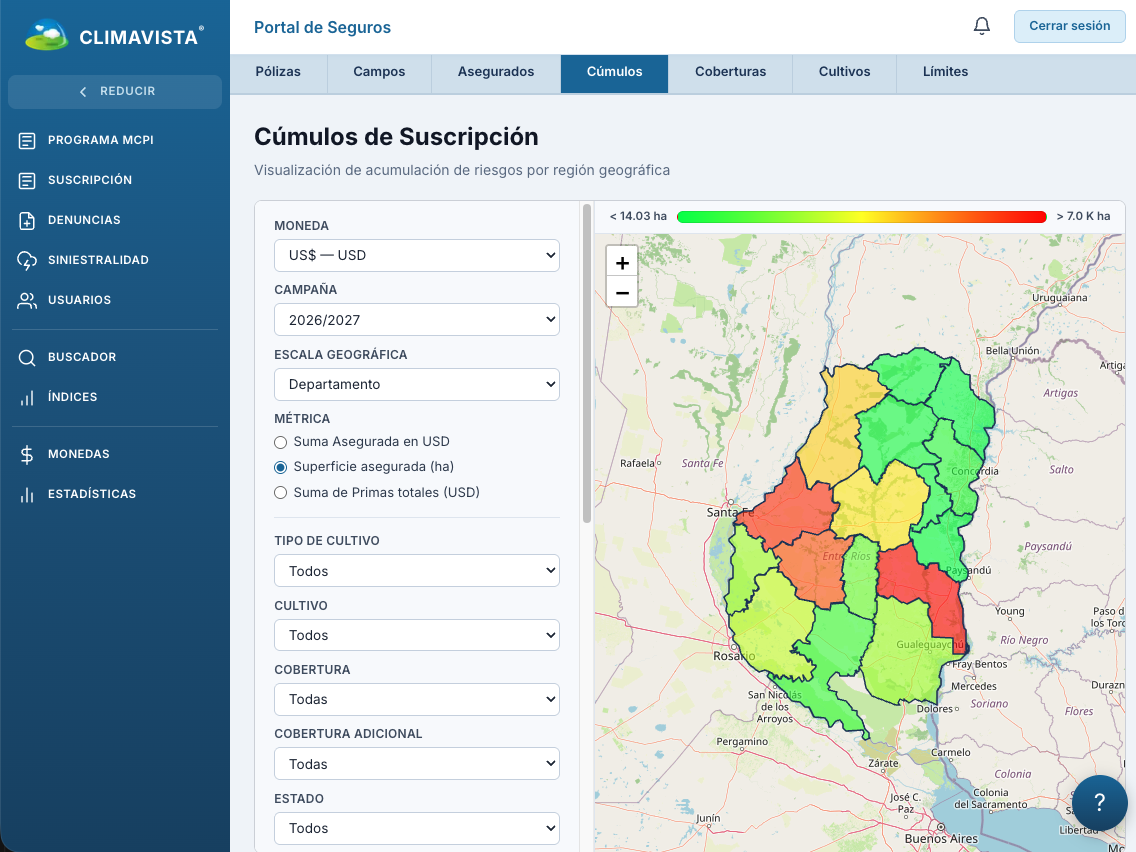
The corn planting window is non-negotiable. It lasts only a few weeks, especially with a Super El Niño in the forecast. A multi-peril crop insurance program that needs to enroll hundreds of growers must therefore be fully operational within that window. This is where most programs fail: not on the risk model, but on underwriting logistics.
The multi-peril program launched by the Province of Entre Ríos, Argentina, driven by Governor Rogelio Frigerio, was built around that constraint. Eight insurance companies operate on a single platform: ClimaVista's. This article looks at what that means in practice, on the technology side and on the administrative workload side.
The bottleneck of a successful innovative agricultural program isn't pricing
When a province and insurers design a multi-peril program, most of the debate focuses on coverage: perils included, deductibles, rates, subsidized share. Those trade-offs are essential. They are not the only limiting factors.
The limiting factor is the execution chain: how a grower located 80 km from the nearest agency office enters a specific company's portfolio, with geolocated fields, a verified acreage and an enforceable certificate — without a back office re-keying every file.
Do the math. Ten minutes of data entry, checking and issuance per file means one person-day for every 48 policies. At the scale of a provincial program, that amounts to weeks of administrative work concentrated in the most pressured period of the year. And every re-keying is an entry point for acreage errors, wrong company allocation or duplicate fields.
WhatsApp isn't a gimmick: it's the front desk where growers already are
Across the Argentine countryside, WhatsApp is the default channel: cooperatives, agronomists, brokers, neighborhood groups. Asking a grower to download a dedicated app, create an account and remember a password for a once-a-year transaction means losing a significant share of the audience before the first question is even asked.
In the Entre Ríos program, the grower starts by scanning their company's QR code. The conversation opens, they answer a series of messages, they declare their fields. No PDF form, no documents sent by email, no office appointment.
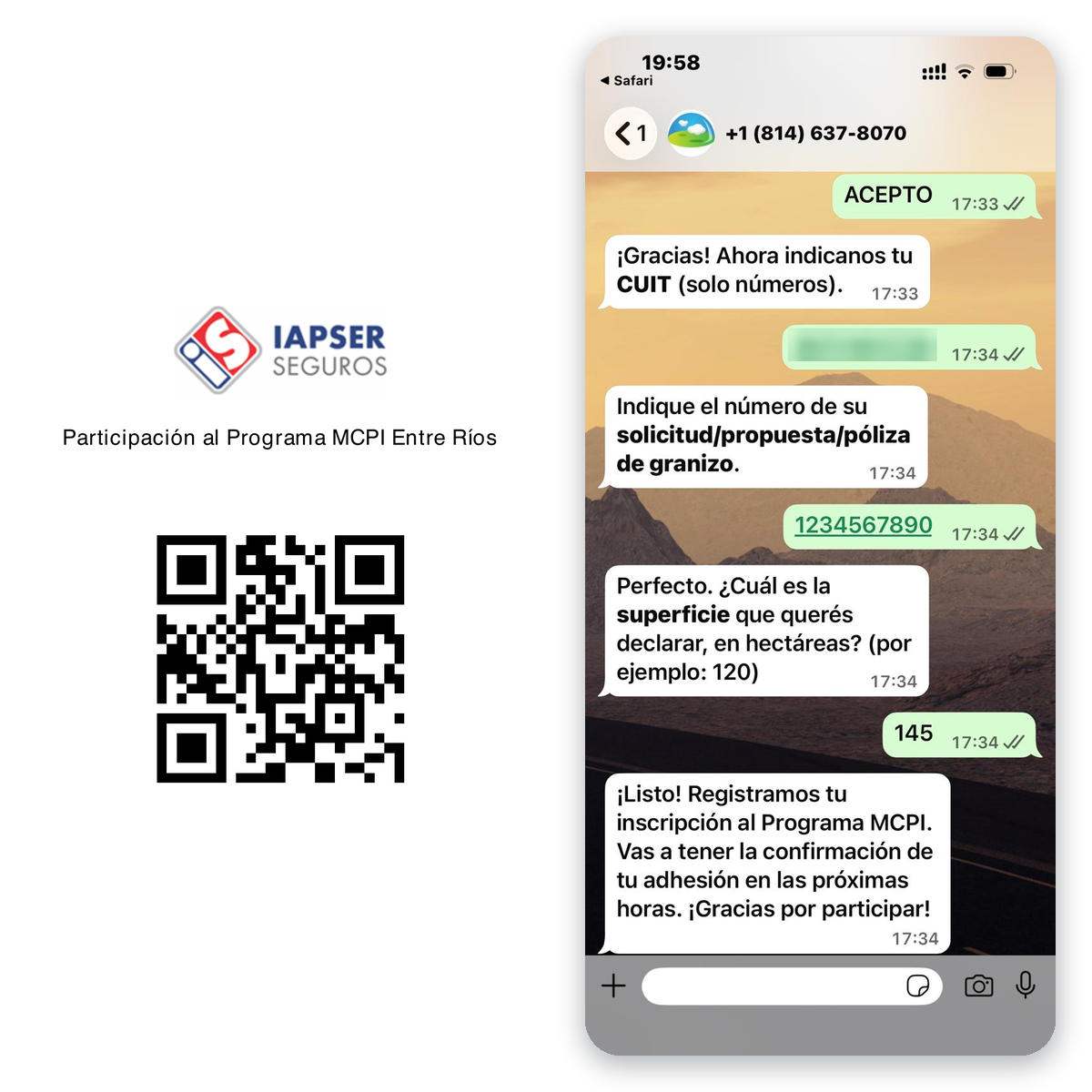
The most important effect isn't usability. It's attribution. Because each company has its own QR code, the file is tied to its portfolio from the very first message. No common pool to split afterwards, no allocation dispute between insurers within the same program. The program's commercial structure is encoded in the entry point.
Eight companies, one platform: configuration rather than development
Having eight insurers coexist within a single setup means reconciling two contradictory requirements: a common framework imposed by the province, and needs specific to each company (branding, underwriting scope, acceptance rules, certificate format, data flows into their policy administration system).
The classic answer — building a custom integration per company — is incompatible with an agricultural calendar. The approach taken here treats each insurer as a configurable space on a single platform: its own entry channel, its rules, its documents, its exports. What changes from one company to the next is configuration, not code.
Direct consequence: adjusting an acceptance rule or a certificate wording takes hours, not release cycles. When a program is launched by a political decision with a firm opening date, that ability to adapt mid-season is worth more than a long feature list.
Validate fields at the source, not at claim time
The costliest risk in an agricultural portfolio isn't always climate-related. It's risk uncertainty: rough acreage declarations, overlapping field boundaries, land whose use doesn't match the insured crop. Those anomalies only surface at claim time — that is, at the worst possible moment, when they turn into disputes.
The program reverses the sequence. Field boundaries are checked automatically at registration, and monitoring relies on INTA's soil productivity index, Argentina's public agronomic benchmark. The anomaly is handled before issuance, not after the loss.
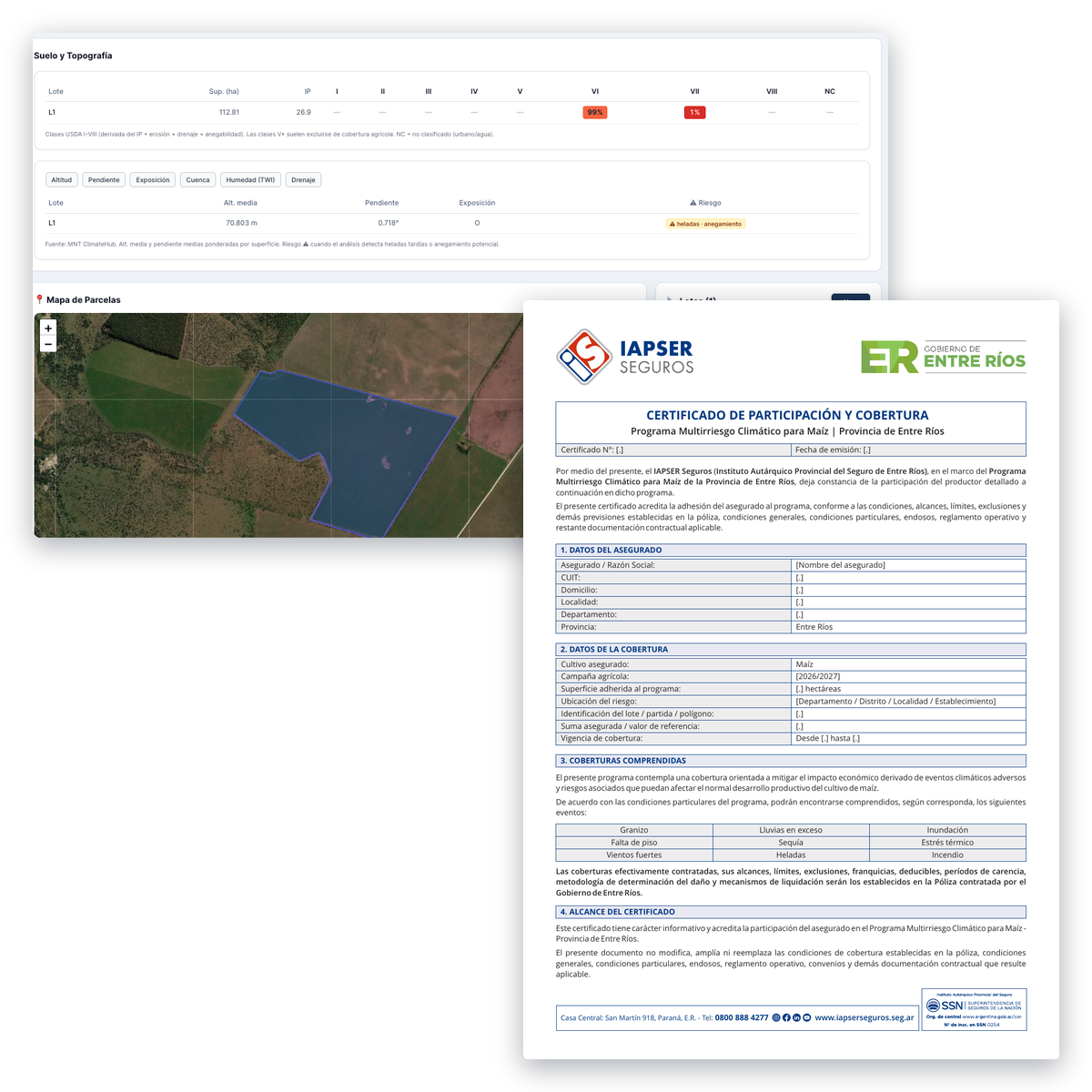
For the company, the benefit is twofold: a portfolio whose acreages are reliable from the outset, hence genuinely measurable exposure; and the elimination of manual certificate issuance. The participation certificate is no longer a document produced after a long administrative cycle, but the automatic output of a successful check.
Claims: qualify before you inspect
The same logic applies downstream. The grower files a claim via WhatsApp, in the same channel used for underwriting — which spares them from learning a new journey under stress.
The declaration is then enriched by the 3CI satellite assessment, which measures damage field by field. The adjuster therefore doesn't receive a raw notification, but a complete file backed by an objective and consistent measurement.
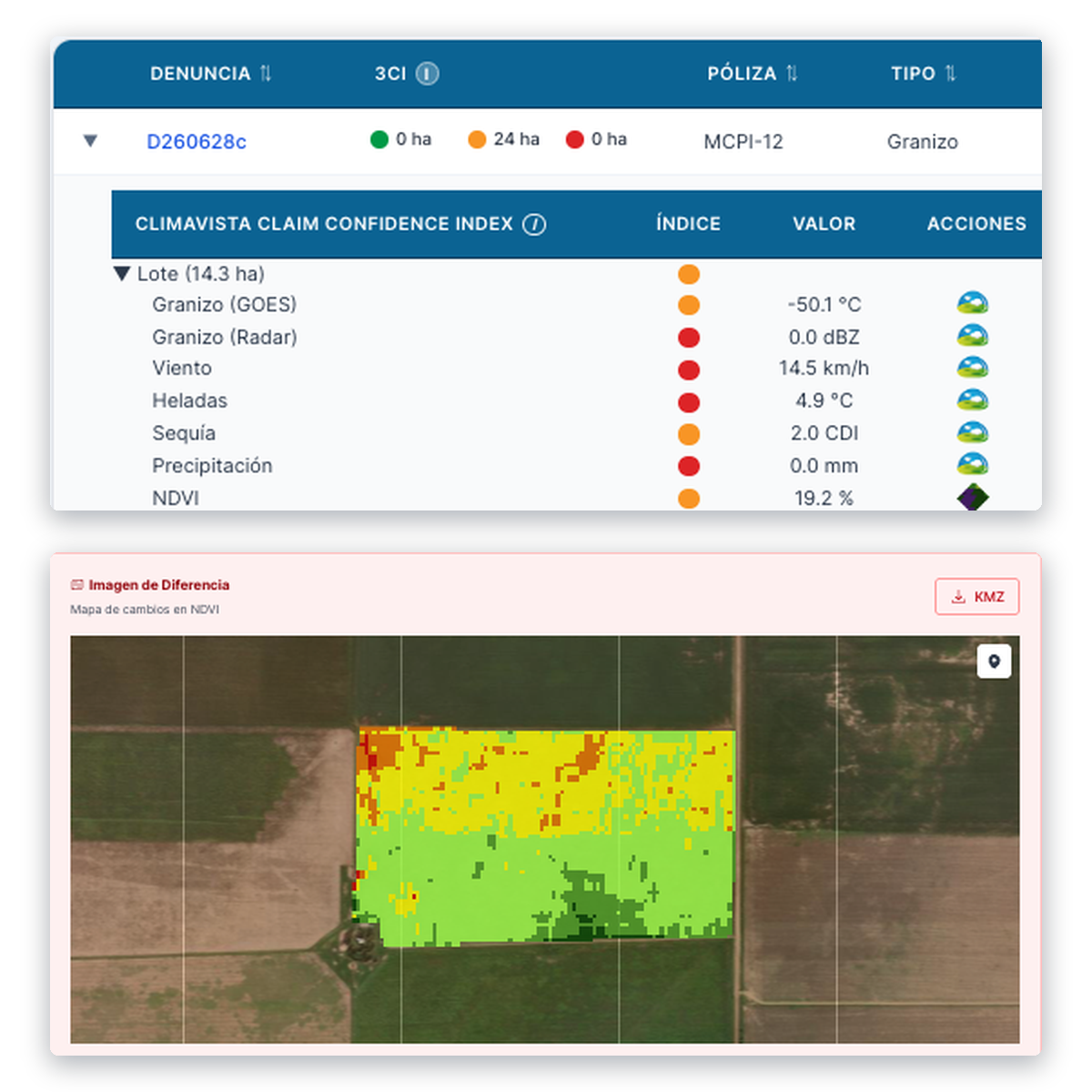
This pre-filtering changes the economics of claims settlement in three ways:
- Visit prioritization. Inspections focus on cases where the stakes justify them, instead of being triggered on a first-come basis.
- Consistency. Two neighboring growers hit by the same event are assessed against the same benchmark, whatever the company or adjuster involved. In a provincial program, fairness of treatment is as much a political issue as an insurance one.
- Fewer disputes. A third-party, documented and reproducible measurement shifts the discussion from perception to data.
What execution speed really changes
Automation is often described as a cost lever. In a seasonal agricultural program, it is first and foremost a coverage lever.
Every week gained on opening underwriting is an extra week of usable window to enroll growers before planting closes. Every minute saved per file is processing capacity that absorbs peaks without hiring seasonal admin staff. And every check moved upstream is a dispute that won't exist six months later.
In other words: automation isn't about doing the same thing more cheaply. It's about making possible a volume and a turnaround that, manually, simply weren't.
Three lessons transferable to other public-private programs
- Start from the grower's channel, not the insurer's system. Take-up depends more on the number of steps asked of the farmer than on the quality of the coverage.
- Encode governance into the tool. A QR code per company isn't a technical subtlety: it's the program's allocation rule, made automatic and indisputable.
- Make public reference data the backbone. Relying on INTA's soil productivity index and on a consistent satellite measurement gives the program a common basis acceptable to all stakeholders — province, insurers, adjusters, growers.
And for your program
If you are designing or operating an agricultural scheme involving several risk carriers, a public authority and a dispersed grower population, the useful questions are simple: how quickly can an insurer be onboarded? How many human minutes per policy? What share of claims can be qualified before an inspection?
Those are the three indicators against which the ClimaVista platform was evaluated by the Province of Entre Ríos and the eight companies in the multi-peril program. We can walk through the full journey — WhatsApp underwriting, field validation, certificate, claim filing and 3CI assessment — on a real case, starting from your own program design.