
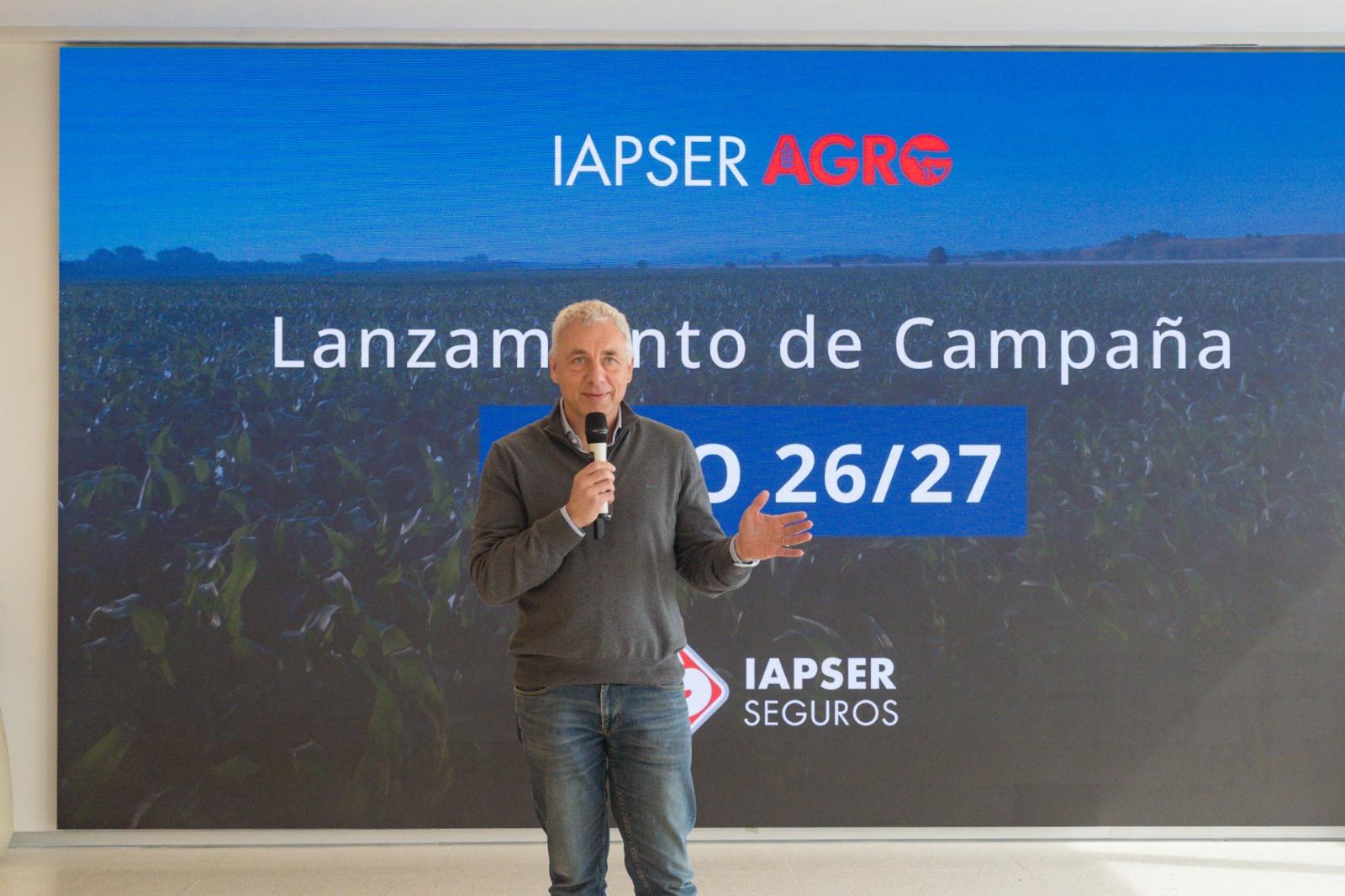
The 26/27 crop campaign was launched in a context that technical teams know well: a season forecast under the influence of a high-intensity El Niño, heterogeneous production areas in terms of soil quality, proximity to watercourses and topography, and commercial pressure that requires fast quoting without degrading the technical quality of the portfolio.
The presentation given at the launch of the IAPSER campaign focused on expected climate trends and on the tools deployed. This article extends that discussion from a different angle: it is not climate data alone that makes the operational difference, it is the speed and reliability with which that data circulates between the parties to a contract — agent, underwriter, policyholder, loss adjuster, technical management.
The real bottleneck is not the data, it is the decision chain
Most insurance companies today have access to satellite data, rainfall series and vegetation indices. The problem is no longer the existence of the information, but its journey.
In a classic setup, an agricultural quotation request goes through a succession of manual exchanges: the agent (PAS) gathers the producer's information, sends an email to the underwriting department, waits for a response, corrects, sends again. Each round trip costs hours or days. During the sowing period, this latency has a direct commercial cost: the producer makes their decision with or without the quote.
On the claims side, the same phenomenon recurs with heavier financial consequences. A notification arrives, must be qualified, a loss adjuster must be appointed, travel to the site, produce a report. Without objective prioritisation, all files look alike and the queue forms at the worst possible moment: after a hail event or a prolonged dry spell, when notifications arrive by the hundreds at the same time.
L'automatisation n'a pas pour objet de remplacer le jugement technique du souscripteur ou de l'expert. Elle vise à leur présenter, au bon moment, un dossier déjà documenté, hiérarchisé et chiffré.
Quotation: industrialising underwriting without over-standardising
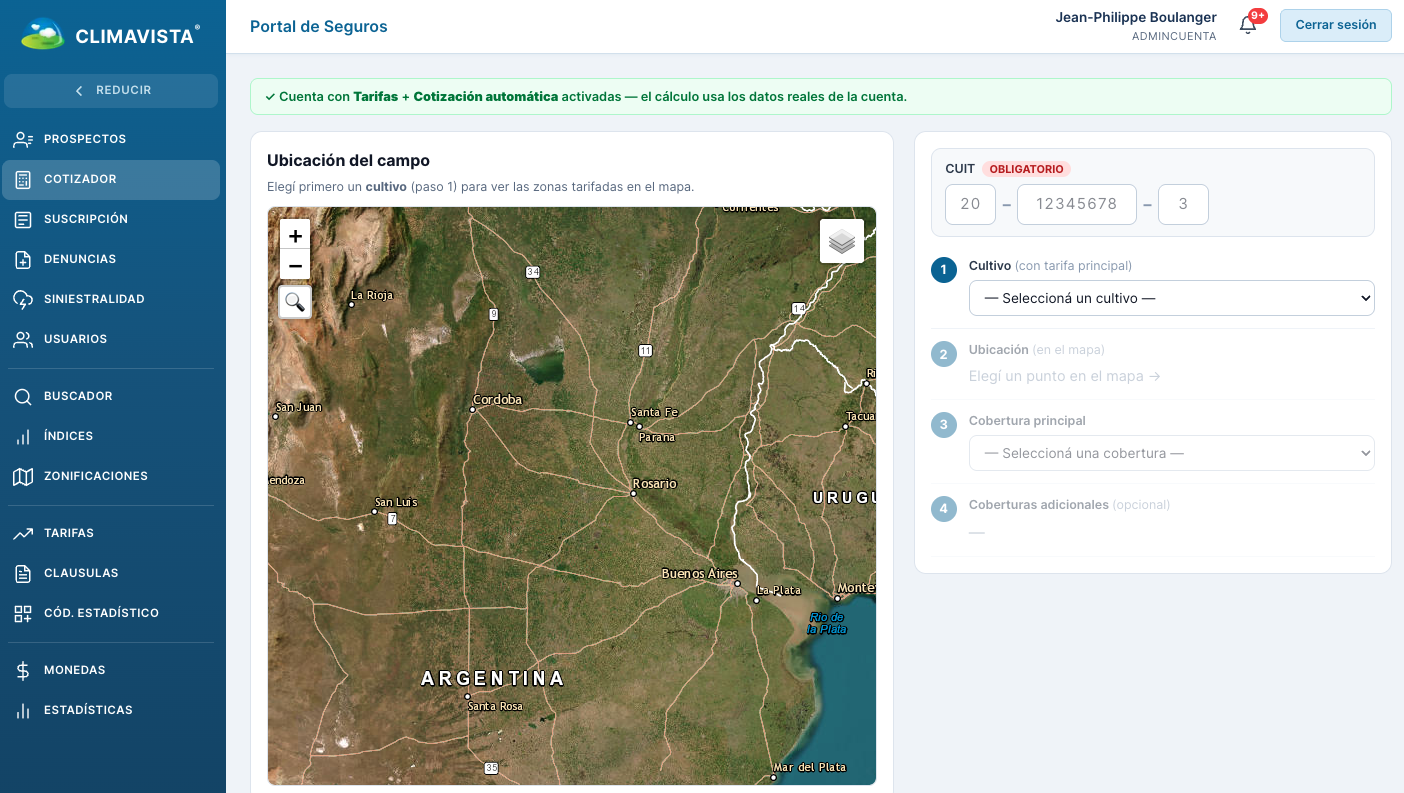
The online rating tool made available to agents primarily meets a simple requirement: that producing a quote no longer depends on the availability of a counterpart.
The agent enters the parameters of the plot — location, crop, area, sowing date, desired level of coverage — and obtains a priced proposal based on the underwriting rules defined by the company. The risk logic remains the insurer's; what changes is the channel and the turnaround time.
But total standardisation is not desirable in agricultural insurance. Some cases fall outside the grids: large areas, high-value crops, particular loss history, requests for atypical deductibles. This is where the second level of the system comes in: the automated exchange between the agent and the Head of Underwriting.
Rather than a free-form email, the off-grid request is transmitted in a structured format, with all contextual elements already attached: mapping of the plot, climate history of the area, seasonal trend indicators. The underwriter does not have to reconstruct the file, they arbitrate it. Their decision is then automatically sent back to the agent, and the final application is generated as a pre-filled PDF, ready for signature.
The most visible effect is not only the time saved per file, but also traceability. Every waiver granted is recorded, justified, measurable. At the end of the campaign, technical management can analyse the gap between the theoretical grid and actual production — an exercise that is rarely possible when decisions live in email inboxes.
AI assistants as a layer for circulating information
The term "AI assistant" covers highly variable realities. In the context of an agricultural insurance contract, the useful application is precise and bounded: read, qualify, summarise, notify.
In practice, several repetitive tasks can be delegated.
Qualification of incoming requests. An assistant extracts the information from a file and analyses both the policyholder's profile and the agro-pedo-climatic characteristics of the plots to be insured, and flags missing items before a human even opens the file. Incomplete files no longer consume underwriting time.
Contextual synthesis. For a given plot, the assistant aggregates the climate history, active alerts and the plot's characteristics into a summary note. The underwriter or loss adjuster starts with context, not with a blank page.
Targeted notification. Each stakeholder receives what concerns them, when it concerns them: the agent is informed that their file has been approved, the loss adjuster that a priority claim has been assigned to them, management that an abnormal concentration of notifications has appeared in a given department.
Un assistant IA ne doit jamais produire une décision d'indemnisation. Sa valeur réside dans la préparation du dossier et la hiérarchisation des priorités. La responsabilité technique et contractuelle reste intégralement humaine.
Early warning: anticipating the workload before it arrives
The early warning dimension is the one that most profoundly changes how teams are organised. Monitoring drought, excess water, hail and frost risks at plot and department level makes it possible to move from reactive management to anticipated management.
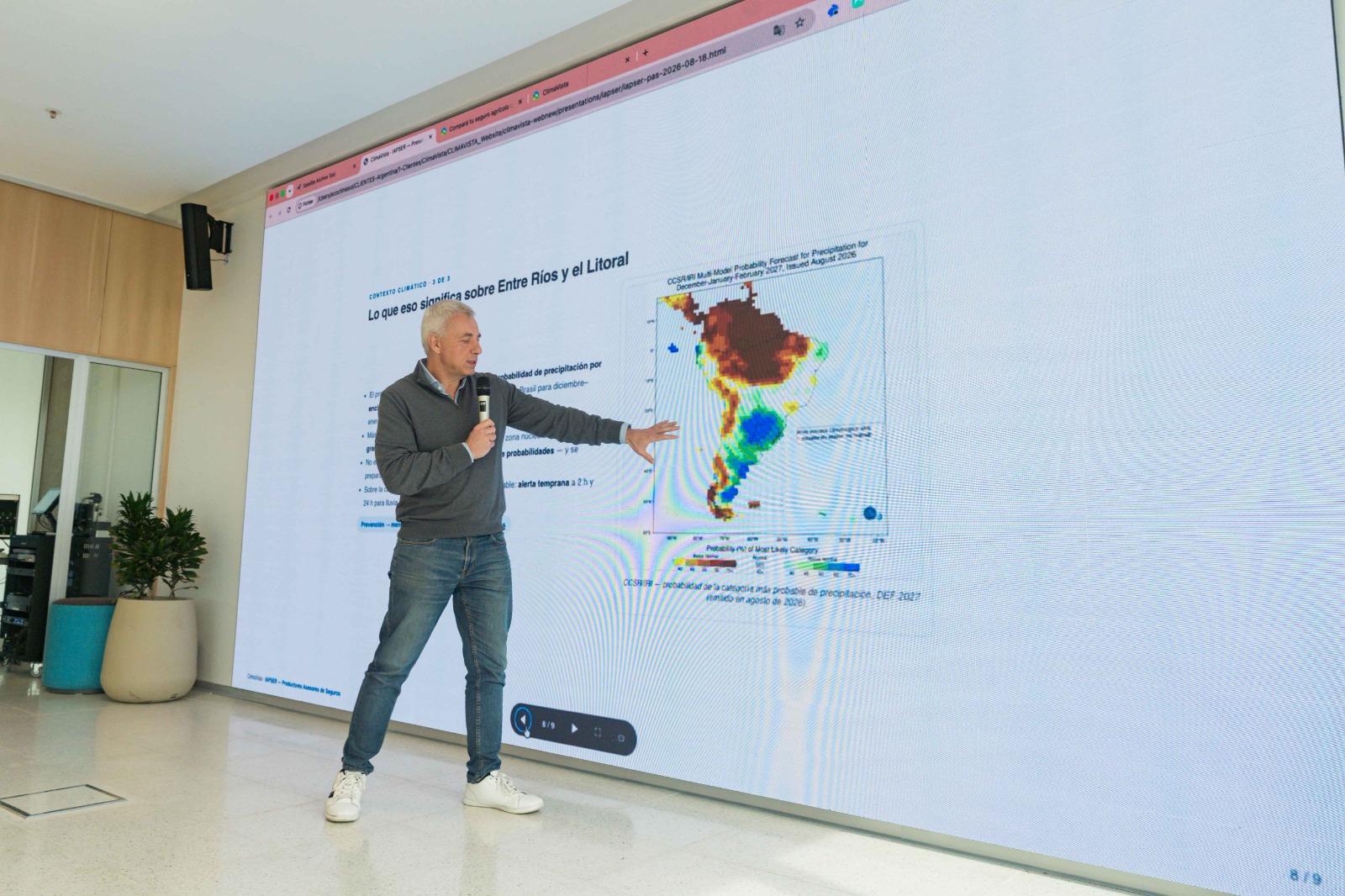
In the high-intensity El Niño scenario tracked for this campaign, the main issue concerns excess water and hail episodes associated with convective systems. Knowing, ten days in advance, that a department concentrates significant exposure enables three concrete actions:
-
Sizing loss-adjustment capacity — mobilising adjusters before the peak in notifications rather than after.
-
Communicating with the agent network — preparing the producers concerned, reducing the volume of unqualified calls.
-
Informing reinsurance and finance — with an estimate of the probable loss burden, rather than a mere after-the-fact observation.
This anticipation also has an indirect effect on service quality: a policyholder who has been warned and supported accepts the outcome of an assessment more easily, even an unfavourable one.
Indemnification: accuracy as a condition of trust
This is probably the most sensitive point of the whole system. In agricultural insurance, a dispute over an indemnity rarely stems from bad faith: it stems from a gap in perception between what the producer observed in their field and what the loss adjuster measured.
Reducing this gap means giving the adjuster objective, dated and geolocated data. The ClimaVista Claim Confidence Index (3CI), calculated automatically for each notification, serves this objective: it cross-references the reported event with the climate and satellite observations available for the plot, and produces a consistency score.
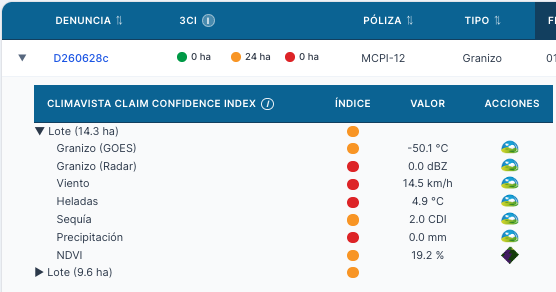
This score is not a verdict. It fulfils three distinct functions.
Prioritising. Files with high consistency and significant financial stakes move to the front of the queue. Manifestly inconsistent files are examined with heightened scrutiny.
Documenting. The adjuster travels with the images and data series for the plot. Their field assessment is based on a shared factual foundation, which shortens the report and strengthens its robustness.
Explaining. When facing a policyholder, a decision supported by dated and geolocated measurements can be justified. This is an often underestimated lever for reducing litigation.
What the 26/27 campaign teaches about change management
Deploying an end-to-end automated chain is not primarily a technology project. Three lessons emerge from this campaign.
Adoption is decided at the agent level. If the online rating tool is not faster than email, it will not be used. The design constraint is not functional richness, it is the number of fields to fill in.
Underwriting rules must be made explicit before they are automated. Formalising the pricing grid is often the hidden benefit of the project: it forces trade-offs that previously relied on individual experience to be made explicit.
Campaign monitoring creates its own demand. Once management has consolidated real-time reports — volumes quoted, conversion rates, loss ratios by department, loss-adjustment workload — it does not go back to quarterly reporting.
Le périmètre à privilégier pour un premier déploiement : une campagne, un jeu de cultures, un réseau d'agents identifié. La valeur se démontre sur un cycle complet, du lancement de campagne au règlement des derniers sinistres.
Towards a continuous agricultural insurance chain
The ultimate goal is not to add tools, but to eliminate discontinuities. Between the moment a producer asks for a price and the moment they receive an indemnity, information should never have to be re-entered, reconstructed or waited for.
The 26/27 campaign shows that a continuous chain is achievable with existing building blocks: a rating tool accessible to the network, structured exchanges with underwriting, automatically generated contractual documents, climate monitoring at plot level, and claims scoring that equips the loss adjuster instead of constraining them.
The benefit is measured along three axes that technical departments already track: quotation turnaround time, the cost of handling a claim and the dispute rate. It is these, more than the sophistication of the models, that determine whether the transformation has genuinely taken place.