
Agricultural insurance is a business where uncertainty is not an accident: it is the raw material. A risk is accepted without knowing whether it will rain, a price is set without knowing the yield, a claim is paid on damage nobody watched happen. Every stage rests on an inference drawn from incomplete information.
This is precisely the terrain where artificial intelligence promises the most — and where it can do the most damage if given the wrong role.
We put two agents into production this year. The first works at underwriting, the second during claim assessment. This piece explains why those two moments specifically, and why we built these agents as documentation tools rather than decision engines.
Why those two moments
In the life cycle of an agricultural contract there are two instants where a decision commits the company durably, and where the available information is structurally insufficient.
The first is the moment you say yes. The underwriter has a few declared elements, an approximate location, possibly an internal history if the client is known. From that they must produce a price and an acceptance decision. What is missing — the real agronomic potential of the soils, the climate exposure of the area, the financial soundness of the counterparty — nonetheless exists as public and satellite data, but assembling all of it by hand takes half a day per file. Nobody does it, except on large risks.
Two blind spots deserve to be named separately, because they touch the very foundation of the contract.
The first is adverse selection. Nothing materially prevents a grower from requesting hail cover after the storm, or drought cover once the water deficit is already established. The underwriter, for their part, has no way of seeing it: they examine an application dated today, not the state of the field last week. That information nonetheless exists. The NDVI trajectory of the field and the sensor history over the preceding weeks tell whether the crop was already degraded at underwriting time — and a drop predating the signature is a signal no declaration will ever provide.
The second touches the very nature of the risk. Insurance rests on an assumption: that the loss is random, and therefore poolable. A valley-bottom field that freezes seven years out of ten does not carry a risk, it carries a certainty — and covering it at the price of a random event amounts to funding an announced loss. Telling the two apart requires looking at several climate dimensions over sufficient historical depth: hail frequency, frost occurrences, rainfall deficits, drought episodes across twenty to thirty seasons. That is precisely what the data we operate makes possible, at underwriting time rather than after the fact, once the loss ratio has already revealed the structural nature of the exposure.
The second is the moment you pay. A claim is filed. The adjuster must establish whether the event happened, whether it hit the fields concerned, and in what proportion. They work with what they see at the time of their visit, often weeks after the fact, on a crop that has kept growing.
These two moments share a characteristic: they are not computation problems, but problems of gathering and reading scattered information. That is precisely what current models do well.
The underwriting agent: a file, not a score
The first agent builds, from the contract data and the georeference of the fields, a risk file structured along four angles.
The agroclimatic angle characterises potential and exposure: soil type and quality, climate history of the area, NDVI trajectory over past seasons, per-field topography — elevation, slope, aspect, topographic wetness index. The credit angle gathers the public financial signals available on the counterparty. The compliance angle checks the consistency of identification data. The fourth produces a reasoned underwriting recommendation.
What matters is not that list, which others could reproduce. What matters is the shape of the result.
The agent does not produce a grade. It produces a file where every statement is linked to its source, where every source is dated, and whose whole is frozen by a fingerprint at the time of analysis.
This distinction is the heart of our technical choice, and it deserves explaining.
A score is an opaque output. It gives a number, it does not give a reason. When an underwriter disputes it, there is nothing to examine. When a regulator questions it, the company has nothing to show. When the model is updated, nobody can reconstruct what the score was worth at the time of the decision.
A cited and frozen file is the opposite. Every conclusion opens onto what supports it. An underwriter who disagrees can point at the source they judge unsound. A controller can retrace the path. And the fingerprint guarantees that the file examined today is the one that served to decide eight months ago — which, in a dispute or a reinsurance audit, makes all the difference.
The architecture: rules where rules belong
A second design decision is worth stating explicitly: the agent is hybrid.
Everything that can be computed deterministically is. An area, an exposure accumulation in dollars, an NDVI average, a slope, a loss ratio: these are arithmetic operations, and handing arithmetic to a language model would be an engineering failure. Those values are computed by code — verifiable and reproducible.
The language model steps in where it contributes something: reading unstructured documents, relating heterogeneous elements, formulating an intelligible synthesis, flagging an inconsistency between two sources. That is reading and writing work, not computation.
This separation has a direct consequence on reliability. A language model's reasoning errors on figures — the area where it is most fallible and hardest to monitor — simply do not exist in this architecture, because it was never asked to perform that calculation.
The claims agent: disagreement as a signal
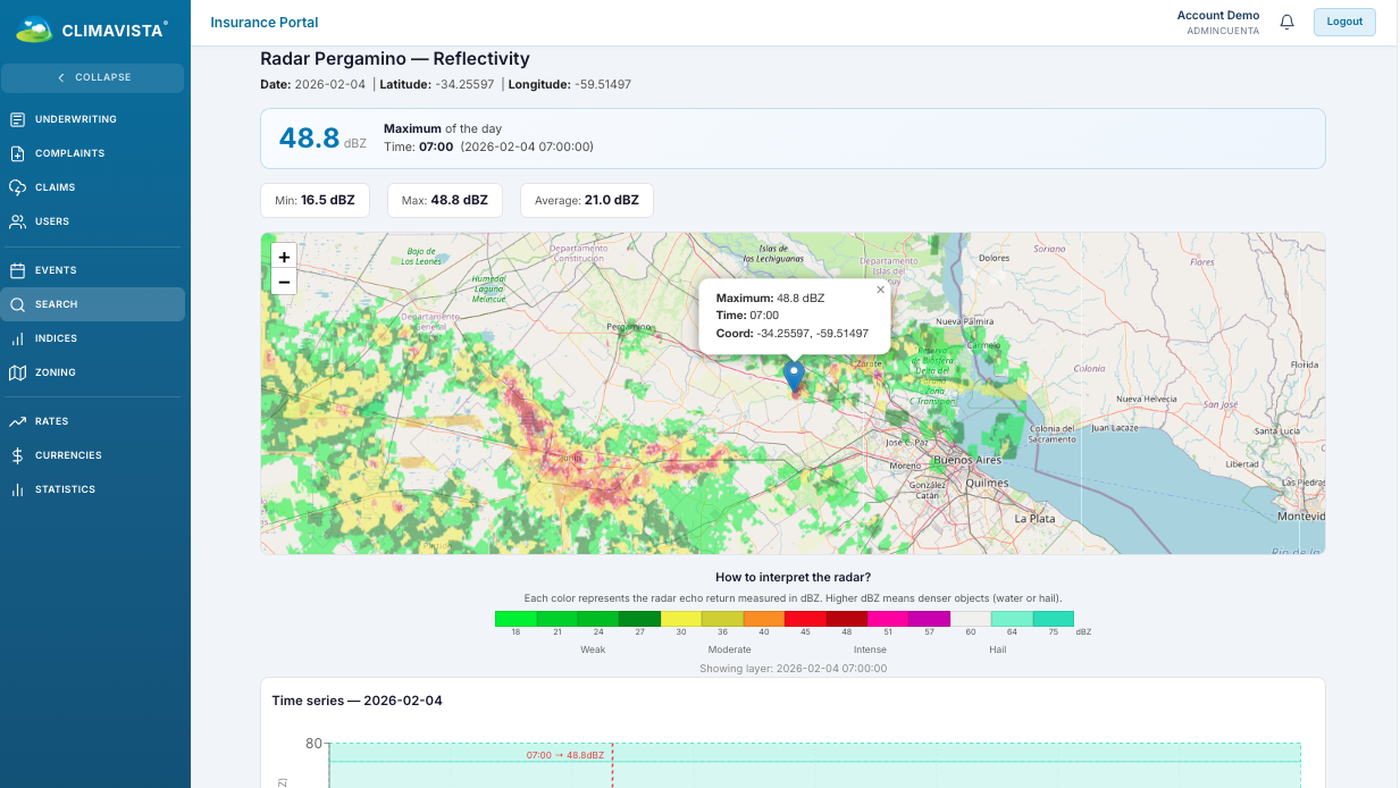
The second agent works on assessment. It reads the NDVI imagery of the field directly, before and after the declared date, and cross-references what it sees with the sensor data available over the same window: hail radar, rainfall, frost temperatures, drought indices, GOES thermal imagery.
The aim is not to deliver a verdict. It is to produce, field by field and then for the whole file, a synthesis of what the data shows — explicitly highlighting points of disagreement.
That is the tool's most useful reversal. When every index agrees, the synthesis merely confirms what the adjuster would have concluded, faster. The value appears when they diverge: a hail claim on a date when the radar recorded nothing, an NDVI drop predating the declared event, a claim filed on a field whose vegetative trajectory stayed normal. These situations do not mean fraud — a sensor can miss a very localised event — but they signal where human expertise should concentrate.
Advisory, and why it is not a token precaution
Both our agents operate in advisory mode. They do not accept a risk, do not set a price, do not reject a claim. This is neither commercial caution nor legal hedging: it is a position on what these systems are good at.
A language model is excellent at gathering and restating. It is poor at arbitrating under uncertainty when consequences are asymmetric — and wrongly refusing a claim does not cost the same as wrongly accepting one. It is also incapable of integrating what the underwriter knows about their market, their relationship with a broker, or the context of a region after a bad season.
The division we settle on is simple: the machine documents, the human decides. The agent takes assessment time from half a day to a few minutes, and makes visible what would have stayed buried. What the underwriter or the adjuster does with that information is their profession.
What it implies for compliance
One last point, too often addressed too late.
We deliberately built these agents around the contract and its risk, not around the insured person. The distinction sounds semantic; it is not. A system that builds a profile on a natural person falls under a demanding data protection regime, with obligations of information, purpose limitation and right to object that weigh heavily. A system that analyses the risk carried by a contract — the fields, the crops, the climate exposure, the geometry — remains within the scope of insurance risk assessment.
That constraint shaped the design from the start, not afterwards. It explains why analyses are attached to the contract, why the cohorts we study are cohorts of contracts, and why the frozen file is retained as supporting evidence for the decision rather than as a behavioural history.
What comes next
Two efforts are under way: one on enriching claims diagnosis with new observation sources, the other on automated risk assessment at field level. In both cases the same constraint applies: what cannot be explained will not be deployed.
Both agents described here are in production on the ClimaVista platform, across partner insurers' portfolios in Argentina.